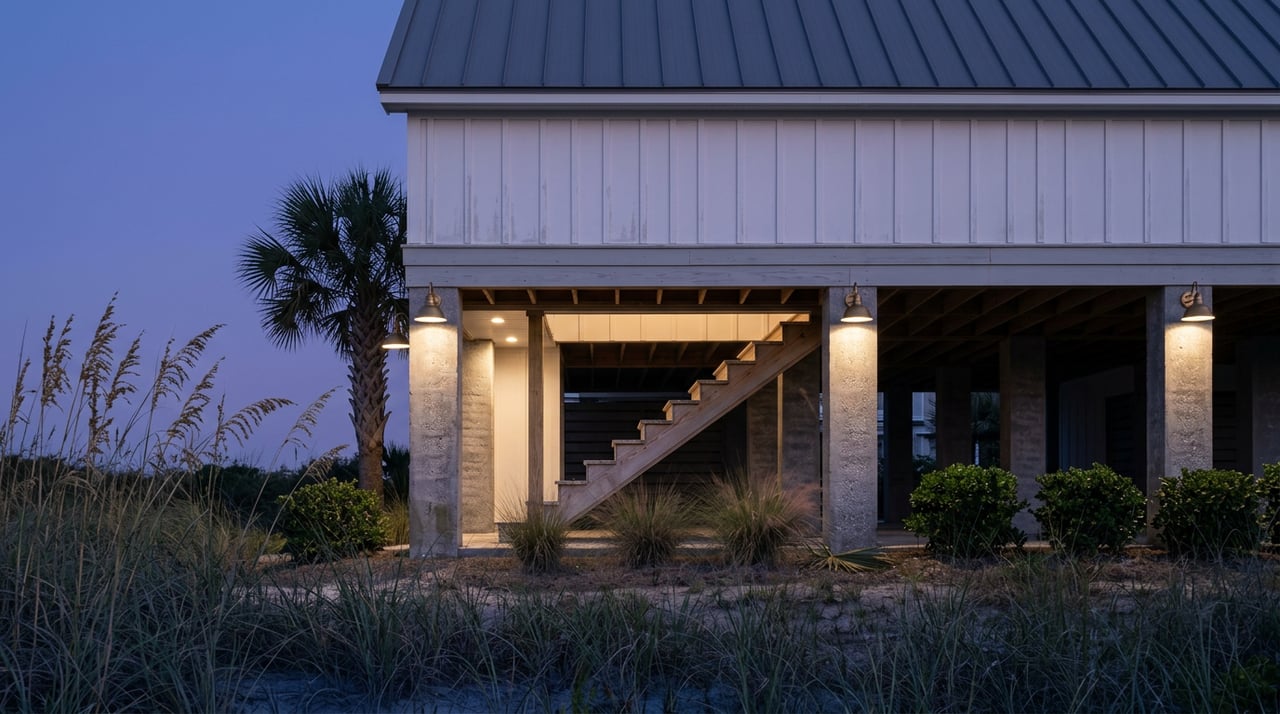
This August, an intersection most residents cross without a second thought became the subject of an algorithm. A porch light became the subject of an ordinance. The sand in front of Wild Dunes became a line item split to the percentage point. And the vague, shared sense of what Isle of Palms actually is became the subject of a paid survey with a marketing firm attached to it.
None of these four things are related on the surface. One is a traffic signal, one is a lighting code, one is a dredge working offshore, and one is a branding exercise. But look at them together and a pattern shows up that says something real about where this island is right now: Isle of Palms is replacing habit with instruments. The informal systems that used to run this place, neighbors keeping an eye on each other's porch lights, drivers developing their own feel for when to avoid the Connector, a shoreline that shifted and rebuilt on its own schedule, a sense of identity nobody had to write down, are all being formalized this summer into numbers, ordinances, and contracts. That is not a small shift for a town that has spent decades running mostly on informal consensus.
The Intersection Learned to Count
Anyone who drives on or off the island during beach season already knows the backup at Palm Boulevard and the Isle of Palms Connector. It has been a fact of island life for years, the kind of thing you plan around rather than solve. The city's answer this year is not a wider road or a longer light cycle. It is artificial intelligence.
Isle of Palms is installing an AI-controlled traffic signal at that intersection, and Deputy City Administrator Sean Kuester described the mechanics to Live 5 News in a way that is worth sitting with. The system detects vehicles as they arrive and treats them almost like a queue to be managed: cars accumulate what Kuester called tokens, and once enough have built up, the system runs a flushing protocol to clear them through. City leaders are careful to say the goal is not zero congestion during a holiday weekend or a July Saturday, but a measurable improvement in the everyday grind. Installation is targeted for completion by March 2027, timed to be ready ahead of the next tourism season.
What is notable is not the technology itself. It is what the technology replaces. For years, the informal solution to Connector traffic was tribal knowledge, residents learning which back route to take, which hour to avoid, which app to check before leaving the house. Now the city is formally instrumenting a problem that residents used to solve one workaround at a time.
The Light You Are Not Allowed to Leave On
A few blocks away, in a much quieter meeting room, the Isle of Palms Planning Commission spent its August 12 meeting on a subject that sounds almost quaint next to an AI traffic signal: how bright your outdoor lights are allowed to be.
City staff told ABC News 4 this was either the third or fourth time the proposed lighting ordinance has cycled through the planning commission, City Council, and the Environmental Advisory Committee since it was first raised. The current draft would require shielding on fixtures near the beach, similar to the hoods already used on the island's street lamps, along with limits on brightness and color temperature and a requirement that lights be turned off when nobody needs them. It also cleans up an old reference to low-pressure sodium bulbs in the existing streetlight code.
Planning Commission Chairman Ron Denton framed the problem in a way that gets at exactly what this whole season is about. He told ABC News 4 the ordinance exists because the island's mix of full-time and part-time residents has stretched informal neighborliness past what it can carry on its own. In his words, when a community has a lot of part-time residences, you cannot count on everyone to pay attention to how their choices affect the people living next door. The rule is being written specifically because the unwritten one stopped being enough.
The ordinance has already passed first reading at City Council, with a second reading expected later this month. If it clears that vote, Isle of Palms will join Folly Beach, Kiawah Island, and Edisto Beach in having a lighting code that reaches beyond the beachfront sea turtle protections the island has had for years, into the interior residential streets where most of the actual growth in outdoor lighting has happened.
The Beach Is Being Rebuilt on a Formula
While the planning commission was drafting brightness limits, a dredge called the Wadmalaw was working the same coastline for a different reason. Crews finished installing the floating pipeline on July 27 and began dredging that same day, part of the island's 2026 offshore renourishment project. The work has been repeatedly delayed by weather since: a storm forecast for August 2 pushed the dredge back into the harbor for cover, and by August 3 it was still sitting in a staging area near Fort Johnson waiting for conditions offshore to clear.
This is not a small maintenance job. The city has requested $5.3 million in state funding and has so far received $1.5 million of it. The rest of the cost is split by a formula that treats different stretches of beach differently: on the north end, covering Wild Dunes and Breach Inlet, the city is paying 47 percent and the Wild Dunes Community Association is covering 53 percent. On the south end, the city is covering the full cost itself. Even the sand under people's feet is being managed according to a negotiated percentage, not left to whatever nature and prior budgets happened to produce.
City Council has also voted to hire the firm Foth/Olsen to study the island's long-term beach restoration strategy, looking for approaches that could extend the life of future sand placements and cut down how often a full renourishment cycle like this one is needed. That is the same instinct running through the traffic signal and the lighting ordinance: stop reacting to the same problem every few years and start managing it on purpose.
Even the Island's Identity Is Getting a Survey
The clearest version of this shift showed up on August 21, when the city announced it had hired Blue Ridge Creative Marketing to lead a branding initiative and launched a community-wide survey asking residents, business owners, and visitors to describe what actually sets Isle of Palms apart.
Councilmember Beverly Miller told Live 5 News the project grew out of a conversation she had with fellow council members earlier this year, one that reaffirmed a vision the city has held for a long time: that Isle of Palms is a family-friendly, primarily residential community. What is different now is that the city is not simply asserting that anymore. It is commissioning research to confirm it, funded through the accommodations tax collected from short-term visitors rather than the city's general fund. Lexi Boese, who leads audience research for Blue Ridge Creative Marketing, described her team's role as listening rather than dictating, gathering resident and visitor perspective before any decisions about logos or messaging get made.
It is a small thing on paper, a survey and some phone interviews. But it is the same move as the traffic light and the lighting ordinance: something that used to live in shared understanding, in this case what kind of place Isle of Palms is, is being turned into data the city can point to.
What This Actually Means If You Live Here
None of these four projects change what Isle of Palms is. The island is still the same slender barrier beach with the same mix of full-time neighbors and second-home owners it has always had. What is changing is how the city manages the friction that comes with growth. For years, the informal systems mostly held: neighbors self-policed their porch lights, drivers absorbed the Connector backup as a cost of living somewhere worth the traffic, the beach rebuilt itself between storms, and nobody needed a survey to know what the island stood for.
This year, on four separate fronts, the city decided that instinct alone was not going to hold anymore. That is not a story about decline. It is a story about a place old enough and dense enough that its informal systems have started to show real strain, and a local government choosing to formalize them before the strain gets worse. Residents watching a dredge work the horizon this month, or waiting on a second reading of the lighting ordinance, or filling out the branding survey, are watching the same story play out four different ways.
If you already call Isle of Palms home, these are the threads worth following into the fall: the second reading of the lighting ordinance, the completion of this renourishment cycle, and whatever the branding survey ends up telling the city about itself. And if you are weighing a move to the island and want a read on how these changes might affect a specific street, block, or property, Lori Petersen can walk you through what is actually happening on the ground, not just what shows up in a council agenda.